I had the honor of being chosen to present at the 2014 “Connect For Success” conference for Ohio educators, sponsored by Battelle for Kids. The event was held at the Hyatt Regency in Columbus, which is attached to the Greater Columbus Convention Center. About a thousand educators from around the state gathered to discuss a variety of topics.
Session over, right? Score one for the anti-tech crowd who says “But if the tech fails, you’re left with nothing” right? Wrong!
The rise of cloud computing has not made me forget my old mantra, “If it’s important, it’s worth having a backup.” I used the backup version of my presentation on my laptop, and video clips of the live demos that I had originally intended to do. Was it optimal? No. But it was serviceable, and allowed me to continue with my presentation.
It served as a very real reminder that the real impact of such presentations is not what happens inside the breakout room, but the changes in instructional practice and approach that occur “back home”.
Despite the ugly technology issues, the session went well. There was good discussion, and some great questions. There was a fresh look at the first step in education for students with unique challenges, thinking about fixing the curriculum before trying to fix the kid.
And that shift of mindset is better than anything the technology can do.
Terence Boylan and Bruce Cook did something awesome. The year was 1957, and the two neighbor boys were interested in model rockets. Terence and Bruce knew what they wanted to do, but they didn’t have the financial resources to make it happen.
And what could have ended right then and there in disappointment turned into something amazing!
If you’re not familiar with their story, go watch this video and/or read this little book. Then come back!
Here are five important lessons we can learn from the true story of The Rocket Boys of NIH:
1) Kids of different ages and abilities can work and learn together. Terence was a fairly typical nine-year-old, but Bruce was 14 and in a wheelchair. In 1957, likely the only time these two boys would have had to pursue their common interest together was after school or in the summer. Fortunately, they were neighbors, so it was easy for the boys to find time to be together. Do students who have little more in common than their interests have the opportunity to pursue those interests together?
2) Asking an expert can be a good strategy. Terence knew that his father got money to do what he did. That is a gross oversimplification of the process, but it led Terence to ask his father, not for the money, but for some expertise. Terence then applied his father’s answer to his own situation and made his own funding request!
3) Use failure as an opportunity to ask “How can we improve?” When early versions of their rocket didn’t launch, or hit the car, or got stuck in the tree, Terence and Bruce were still so enthusiastic about their project that they didn’t let the setback stop them. They learned from observing and analyzing their failed attempts, and tried again, and again.
Terence Boylan’s letter to NIH.
4) Don’t be afraid to ask. They had no official form or insider contact at NIH for their request. They just had an interest and an idea for a project. Then, most importantly, Terence wrote and mailed the letter. Without that, none of the rest would have happened.
5) Support someone’s dream, even if it isn’t “your field”. The NIH (National Institutes of Health) had nothing to do with funding experiments in space travel, either in 1957 or today! The NIH couldn’t fund Terence and Bruce’s project, but the reviewers decided they could, privately. In 1957, ten dollars would have bought about 32 gallons of gasoline. Knowing that they had received a “grant” to work on this project gave Terence and Bruce even more urgency to see their project through to completion!
“Sesame Street” first aired in 1969. I was born in 1971. We’re practically twins.
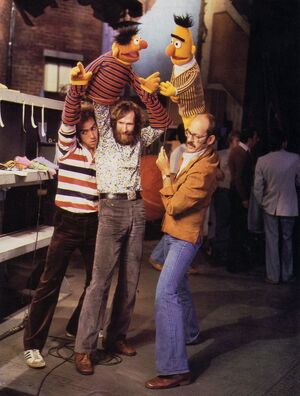
As I grew up watching the show, I was particularly drawn to the characters Bert and Ernie. In many ways, they were as different as they could be. Ernie’s short, broad head and horizontal stripes conveyed happiness from first sight. Bert’s long, narrow head, vertical stripes and bushy eyebrows practically triple-dog-dared you to like anything about him.
But no matter what life threw at them, they handled it and came out better on the other side.
Here are five important lessons about learning that I got from Bert and Ernie.
5) Bert and Ernie respect each other’s differences. Bert and Ernie are different in a lot of ways, but they know they can still be friends .
And did you ever notice anything different about Ernie’s and Bert’s hands? “Ernie is a Live-Hand Muppet (unlike Bert, who is a Hand-Rod Muppet), meaning that while operating the head of the puppet with his right hand, the puppeteer inserts his left hand into a T-shaped sleeve, capped off with a glove that matches the fabric “skin” of the puppet, thus “becoming” the left arm of the puppet. A second puppeteer usually provides the right arm, although sometimes the right arm is simply stuffed and pinned to the puppet’s chest.” – Muppet Wiki
4) Bert and Ernie learn together, through their differences. When Bert and Ernie see or do the same thing in different ways, they talk about it. And when they combine their unique perspectives and talents, great new things emerge (like combining boring ol’ bread with sticky ol’ peanut butter)!
3) Bert and Ernie get on each other’s nerves. And that’s perfectly okay. A few tight-lipped grumbles aren’t enough to cause them to abandon each other. They address the situation themselves, without someone swooping in to save the day for them.
2) Bert and Ernie could “go solo” when they wanted or needed to. Two of their most iconic songs are Ernie’s “Rubber Duckie” and Bert’s “Doin’ the Pigeon”. They were able to do something great on their own when called upon, and it was about something they really loved.
1) Bert and Ernie allowed others to learn and play with them, too. I was so jealous of Shola Lynch getting to spend time with Bert and Ernie. Even with the seemingly perfect dynamic that Bert and Ernie have going, they aren’t isolated from the rest of the Sesame Street community! Sometimes you see Bert without Ernie, or Ernie without Bert, or you see someone else along with Bert and Ernie! The interactions change because of the “personality” of the characters, but they are always Bert and Ernie.
Twiddlebugs and Bottle Caps. Rubber Ducky and Oatmeal. Drums and Pigeons. Practical Jokes and Paper Clips. Hard to imagine one without the other.
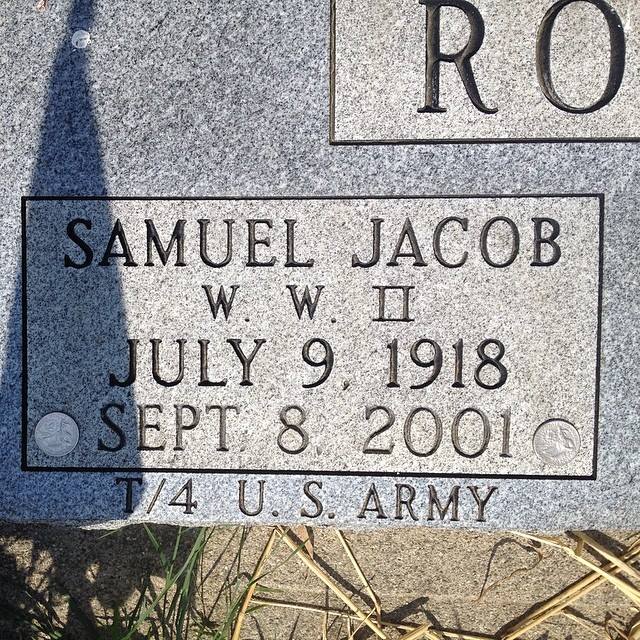
The remains of both of my grandfathers are buried in the same section of the same cemetery (Buford Cemetery, near Buford, Ohio). They both served in the U.S. Army in World War II.
A ceremony is held there each Memorial Day. A small parade leaves from the Clay Township Community Park (old Buford School) and proceeds to the cemetery. At the cemetery, the flag is lowered to half-staff and there is a 21-gun salute, followed by the playing of Taps. Members of the Highland County Veterans Honor Guard perform the flag and rifle rituals. Members of the Whiteoak High School Marching Band performed Taps.
Knowing that these sorts of ceremonies happen, and actually being there for one, are two very different things.
Tom Kitchen [ website | twitter ] and I had the great honor of being asked to conduct a webinar for INFOhio on strategies and tech tools to support struggling readers in grades 6 through 12.
INFOhio provides an archive of the webinar you can view. Once you view the webinar, you can answer five questions to receive a certificate of completion.
The structure and strategy recommendations were taken from a “Doing What Works” collection called “Adolescent Literacy”. That resource is no longer available online, but you can currently get the resources on CD. These are available for free, while supplies last, from WestEd. There are six 2-hour modules, and they can be used by individuals or groups to help plan strategies for improving adolescent literacy at your school.
This was my second time presenting in a webinar for INFOhio! The first was in April of 2013, as part of a “Web 2.0 Smackdown”. Five presenters each briefly demonstrated a great online tool, and you can still view that webinar as well! I demonstrated Popplet, which I also briefly mentioned in the Support Struggling Readers webinar.
Today, it’s easier than ever to write, edit, and publish your own material. Until recently, if you wanted your material to be viewable by the broadest range of people, you were pretty much stuck with using the Portable Document Format (PDF) for your work. PDF is a light (compared to images) format, and allows you to produce print-quality page-size copy in color. But, eventually you will want to dabble with Interactive Media, and you’ll outgrow PDF like your first pair of baby shoes.
Enter ePub. The ePub format takes a standard book-page format (with text and images), and adds the ability to incorporate various multimedia elements (like sound and video). To view an ePub document, you’ll need an ePub viewer. Depending on the device(s) you like to use, several good free ones are available!
Free ePub Readers
Depending on what type(s) of devices you use, you’ll need to find a program or app that will read the ePub format.
iBooks (iOS) – If you have an iPhone, iPad, iPad Mini, or iPod Touch, iBooks is the way to go. Lots of free books are available from the iBooks Store, and it will view PDFs and of course ePubs. The iBooks Store offers “Enhanced Books” that include multimedia elements embedded in certain pages.
Booki.sh (Web-based) – Booki.sh is a web-based service that lets you manage and read ePub (and other format) documents online. This is a great option for a user with multiple devices who has Internet access practically any time.
ePubReader (Firefox extension) or Readium (Chrome extension) – Read and manage ePubs right inside the browser. Chose the one that matches the browser you are currently using. If you’re not using Firefox or Chrome (why not???), try Booki.sh above.
Adobe Digital Editions (Mac, Windows) – If you insist on reading ePubs on a Mac and not doing it through the browser, Adobe Digital Editions is my first suggestion. Also, some screen reader programs have difficulty navigating and handling ePubs inside a browser window, so Adobe Digital Editions may clear up some of those issues if you’re trying to use, for instance, NVDA on Windows or VoiceOver on a Mac.
MobiPocket (multiple)- Some of my friends love this one. I haven’t used it yet, but it looks nice. Allows annotation and can be used across multiple devices and platforms. The one-click dictionary is an impressive looking feature as well!
Now that you have an ePub reader, you need an ePub to read! How about this one I made using the Book Creator app on an iPad Mini? It is all about Amelia’s trip to the Cincinnati Zoo with her pre-school class. Book Creator is available for both the iPad and Android tablets.
On Monday, May 5, 2014, I will be playing some bad golf, for a great cause!
Some great people will be at Snow Hill Country Club for the 22nd Annual SATH Celebrity Golf Classic.
Proceeds from the tournament, and the Sports Memorabilia Auction to follow, will benefit KAMP Dovetail, a summer camp opportunity near Hillsboro, Ohio, for kids with special needs.
Cincinnati sports figures like George Wilson, Jeff Hill, and David Fulcher are mainstays at this event. I’ve had the good fortune in past years to have each of them in my group, and they make a round of golf as much fun as my bad golf game can be!
Rumor has it that another Cincinnati sports hero from my youth will be there this year. Ron Oester. I have two of his baseball cards, from the last couple years he was in the big leagues. I’m planning to take them to the auction. Perhaps he’ll sign them and we can see how much they bring for the cause!
With any luck, I’ll have some pictures and stories on Monday.
I was recently asked for a list of some videos that I have used to illustrate the importance and effectiveness of assistive technology for students. Here is (in no particular order) my “top ten list” of videos I use to inform others about the possibilities with assistive technology and get them excited about what they can do!
1) Cheryl and Morgan: Learning Independence – Google produced this video of a high school student named Morgan, and her use of some built-in features of Google Search and Google Drive. I’ve had the pleasure of meeting Cheryl and Morgan via Google Hangout, and the impact was superb!
3) A Pivotal Role in the Household – ALS doesn’t prevent Marie-France from researching, writing, and helping manage the house, all by only moving her jaw muscles!
4) Fun Theory: Piano Staircase – Tech doesn’t have to make things easier, simpler, or quicker. Sometimes, the point of technology is to make tasks more engaging.
5) the MaKey MaKey – Part of the allure of this device is the endless possibilities for alternate input devices. Another important part of the allure of this device is kids coming up with their own creative and inventive uses for it!
6) The Marshmallow Challenge – The system is there to support the student, not the other way around. This video highlights the importance of keeping focus in any project, and the need for constant evaluation and revision of the structures we put in place to make sure they are still providing the necessary support.
9) Encourage the Runner – Even if you’re not the runner, you can encourage the one who is running his own race. Side note, this happened at Colonial Hills Elementary in Ohio, where a friend of mine has a son attending.
10) We’ll Always Need Paper – Yep, this one is pretty much just comic relief. But, I do think it helps drive home the point that the technology should not drive the goal. The goal should drive the choice and implementation of technology.
“Any observed statistical regularity will tend to collapse once pressure is placed upon it for control purposes.” [Goodhart, Charles (1981). “Problems of Monetary Management: The U.K. Experience”. Anthony S. Courakis (ed.), Inflation, Depression, and Economic Policy in the West (Rowman & Littlefield): 116.]
Educators are relying more and more on data to inform their work. Individual teachers are using hard data to make decisions about instructional practice (Formative Assessment, anyone?) and whole states are making policy decisions based on “what the data says” (Third Grade Reading Guarantee, anyone?).
The phenomenon is not unique to education. But, we may not be as far down the road as other professions. Professionals in other fields have experienced their own versions of “data-based decision making” and learned much from the experience.
For instance, here is a classic economic example. A certain factory produces nails. The owner of the factory finds that productivity and profits are at their peak when the factory produces 100,000 nails per week. This becomes a target, in the form of a quota. The factory workers begin cranking out some very small, shoddy nails that can be produced quickly. The workers easily make the 100,000 target, but it has ceased to be a good indicator, because the nails that are now being produced are useless.
Here is a hypothetical example as it might happen in a school. A school records copious amounts of data on student behavior and discipline efforts over an entire school year. At the end of the school year, staff members analyze the data and determine that in 30% of instances of student behavior that resulted in suspension or expulsion, the student was wearing a black shirt, and that figure is far higher than any other shirt color. Based on this data, the school proposes a new rule for the next school year… students may no longer wear black shirts to school.
The indicator has become the target. Rather than trying to reduce or eliminate the real target (behaviors that resulted in suspensions), the school has addressed the indicator (shirt color). There is an underlying belief that the target and the indicator are so tightly linked that reducing one automatically results in the reduction of the other.
The Third Grade Reading Guarantee
More than half of US states now have some form of a “third grade reading guarantee” in place. These have been sparked by volumes of data about overall student performance linked to the student’s proficiency in reading by the end of third grade. One such example from the Annie E. Casey Foundation study “Early Warning Confirmed” draws such conclusions as “children who do not read proficiently by the end of third grade are four times more likely to leave school without a diploma than proficient readers.” [http://www.aecf.org/~/media/Pubs/Topics/Education/Other/EarlyWarningConfirmed/EarlyWarningConfirmed.pdf, page 4.]
This is certainly actionable data. But, if we place our emphasis there, will we accomplish the real target? Or will we just destroy the usefulness of third grade reading ability as an indicator of likelihood to graduate? In effect, will our approach just change the color of the students’ shirts?
Correlation vs. Causation
From xkcd.
If education and economics aren’t enough voices, let’s let the world of statistical science weigh in. “Correlation” is when two sets of statistical data are closely related, so that when one changes, so does the other. “Causation” is when the existence of one circumstance causes another to happen (e.g., when I push the power button on my laptop, that causes it to turn on). If two sets of data are correlated, we sometimes leap to the conclusion that one of them is causing the other. We look for an explanation of the phenomenon.
Another example looks at the number of highway fatalities in the US, and the number of metric tons of lemons imported from Mexico to the US. The accompanying graph clearly demonstrates that as the number of metric tons of lemons imported from Mexico increased (from 1996 to 2000), the number of US highway fatalities reduced at an incredibly similar rate. We quickly jump from looking at the data to analyzing it by asking ourselves, “Why would increasing lemon imports reduce highway fatalities?” And many of us also quickly come to the conclusion that no such link exists, and the extremely close correlation is nothing but coincidence. A data-based decision in this instance would say that if you want to reduce highway fatalities even more, then lemon imports should be increased. And nothing in our minds tells us that makes any sense.
Do imported lemons reduce highway fatalities?
Do What’s Right For Kids
None of these considerations should ever trump the foundational concept of “doing what is right for kids”. Even if locking my daughter in a room by herself and giving her electric shocks while reading caused her to retain more of what she reads and score higher on standardized reading assessments, I would still fight against them because they are wrong. Whether my kids are able to read at the third-grade level by the end of third grade is one indicator of their likelihood to graduate. However, whether they have a passion for learning is an even stronger indicator of whether my kids will succeed at school, and in life. Any approaches that hinder or squelch that passion are wrong, regardless of any indicators that they support.
The “Unmeasurable” Cause
I am quite certain that the conclusion from the Annie E. Casey Foundation about reading proficiency by the end of third grade is correct. But, I also believe that we make the mistake of taking correlation for causation, and fall deep into the pit of Goodhart’s Law, when we make third grade reading proficiency (or any other measurable indicator) our explicit target. It may well be that the most affluent neighborhoods have a high percentage of yellow houses, but we do nothing to affect the socio-economic status of a neighborhood by requiring them to paint all their houses yellow, even if we provided all the materials and labor to do so.
Reading at third grade level by the end of third grade, graduating high school, and a host of other academic achievements are all attributable to a passion for learning. That passion is largely not measurable, and thus it confounds the success formulas of those who wish to create whole cultures of data-based decision making, where experience, intuition, and passion are ignored when they contradict the conclusion pointed to by the almighty data.
This is not to say that data should be ignored. Data can give us great insights into the effectiveness of instructional strategies and projecting student achievement. Data can help us see holes where they weren’t clear before, or make us face up to deficiencies that we did not (or did not want to) acknowledge by our own subjective perceptions. However, we cannot allow data to make decisions for us, especially when experienced educators know the conclusions to be (at best) unrelated, or (at worst) detrimental to students.
The next time you are in a district/building/teacher leadership meeting, and the data being presented says you should take a certain course of action, and you know that action is no good, remember Goodhart’s Law, and ask yourself if you’re really just telling the students to change their shirts.





 michaeldroush.org