Tag Archives: learning

Syzygy: The 2024 Ohio Educational Technology Conference

I attended the Ohio Educational Technology Conference in Columbus, Ohio, from February 13-15, 2024. This annual gathering is in its second year of returning to a face-to-face model after many successful years of in-person conferences were interrupted by two years of Covid-protocol enforced virtual options. This year’s conference theme was “Syzygy.”

In April, Ohio will be a popular destination for sightseers, looking forward to a rare example of syzygy – the sun, earth, and moon will be aligned in such a way that a total eclipse will be observable across a wide band through the state.

The 2024 Ohio Educational Technology Conference capitalized on this highly-anticipated astronomical event to draw a comparison to the alignment we seek between teaching, learning, and technology. Syzygy.

While we continue to answer the questions about how to most effectively use the technology we have to help more students achieve more, we find ourselves faced with new questions and new challenges, like how to address the sudden proliferation of artificial intelligence tools.

Here are my top takeaways from OETC 2024.

  • Artificial Intelligence (AI) is the next big opportunity and the next big problem. When calculators became small and cheap, we wondered what would happen to math class. When Internet search engines came into their own, we wondered what would happen to the reference section of the library. AI has us wondering what will happen to students learning to write papers, computer programs, and just about anything else. I heard lots of examples of how teachers can use AI right now to save time and improve their practice. I likewise heard lots of warnings about students misusing AI or accessing tools they should not. We haven’t established a clear direction around expectations for its use, mostly because what AI can do seems to expand every day. Right now, the only bad answer is to pretend it doesn’t exist and that our students aren’t already using it. Ohio and aiedu.org have collaborated to publish an AI Toolkit for schools and their communities.
  • Students consuming information is now an assumption. With so many formats and delivery mechanisms available, curating quality content is the order of the day, not simply providing it. The power of digital technologies has made it easier than ever to have students creating high-quality products of their own. In a year where colleges are debating whether to continue to ask for students’ SAT scores, students are posting links to the books they’ve authored, movies they’ve directed, and songs they have written and recorded and mixed. Tools like Canva, Flip, and Book Creator put the power of publishing to a global audience at students’ fingertips.
  • Innovative practice, thoughtfully implemented, is what will lead to a bright future. Keynotes by George Couros, Dr. Chinma Uche, and representatives from Chagrin Falls Exempted Village Schools emphasized overcoming fear and inertia in systemic practice. While chasing every shiny new tech tool creates chaos that leads us nowhere, we likewise cannot rely on what we have always done to get better results for more students. STEM and real-world impact are no longer the privilege of a few students identified as qualified to participate. Each student deserves access to quality instructional materials and tools to achieve what was not possible before. And we cannot rely on doing what we have always done to get results we have never gotten.

The future, and the present, belong to them. Our job as educators has always been, and continues to be, to guide them in creating a better world by aligning the tools, the skills, and the opportunities that they will need.

Syzygy.
Ten Important Things Amelia Needs You to Know

Ohio’s State Professional Development Grant (SPDG) provides resources for select districts to participate in important work around changing outcomes and improving achievement for diverse learners.

I was honored to be asked to speak at a state-level meeting of SPDG district representatives at the Battelle for Kids “Connect for Success” conference.

My presentation was titled “Ten Important Things Amelia Needs You to Know”.  Big thanks to my friend Patti Porto for getting video of the presentation for me!

The slides are available at goo.gl/8YisM1.

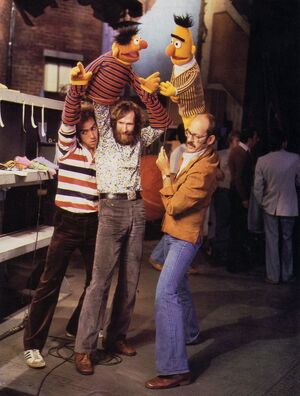
Learn Like Bert and Ernie

Sesame Street” first aired in 1969. I was born in 1971.  We’re practically twins.

As I grew up watching the show, I was particularly drawn to the characters Bert and Ernie.  In many ways, they were as different as they could be.  Ernie’s short, broad head and horizontal stripes conveyed happiness from first sight.  Bert’s long, narrow head, vertical stripes and bushy eyebrows  practically triple-dog-dared you to like anything about him.

But no matter what life threw at them, they handled it and came out better on the other side.

Here are five important lessons about learning that I got from Bert and Ernie.

5) Bert and Ernie respect each other’s differences.  Bert and Ernie are different in a lot of ways, but they know they can still be friends .

http://www.sesamestreet.org/videos#media/video_5b0cf7e8-4231-11dd-8df7-9909703b6a2f

And did you ever notice anything different about Ernie’s and Bert’s hands?  “Ernie is a Live-Hand Muppet (unlike Bert, who is a Hand-Rod Muppet), meaning that while operating the head of the puppet with his right hand, the puppeteer inserts his left hand into a T-shaped sleeve, capped off with a glove that matches the fabric “skin” of the puppet, thus “becoming” the left arm of the puppet. A second puppeteer usually provides the right arm, although sometimes the right arm is simply stuffed and pinned to the puppet’s chest.”Muppet Wiki

4) Bert and Ernie learn together, through their differences.  When Bert and Ernie see or do the same thing in different ways, they talk about it.  And when they combine their unique perspectives and talents, great new things emerge (like combining boring ol’ bread with sticky ol’ peanut butter)!

http://www.sesamestreet.org/videos#media/video_f222bb4e-9f4b-4ecc-92d0-715cd5a61dfe

3) Bert and Ernie get on each other’s nerves.  And that’s perfectly okay.  A few tight-lipped grumbles aren’t enough to cause them to abandon each other.  They address the situation themselves, without someone swooping in to save the day for them.

http://www.sesamestreet.org/videos#media/video_f6bb4f40-1786-11dd-a201-fb0ceede6a0f

Banana in the Ear http://www.sesamestreet.org/videos#media/video_de4ab567-155e-11dd-a62f-919b98326687

2) Bert and Ernie could “go solo” when they wanted or needed to.  Two of their most iconic songs are Ernie’s “Rubber Duckie” and Bert’s “Doin’ the Pigeon”.  They were able to do something great on their own when called upon, and it was about something they really loved.

Doin’ the Pigeon – http://www.sesamestreet.org/videos#media/video_d56fd7ac-1570-11dd-bb51-597ab51d2e81

Rubber Duckie – 

1) Bert and Ernie allowed others to learn and play with them, too. I was so jealous of Shola Lynch getting to spend time with Bert and Ernie.  Even with the seemingly perfect dynamic that Bert and Ernie have going, they aren’t isolated from the rest of the Sesame Street community!  Sometimes you see Bert without Ernie, or Ernie without Bert, or you see someone else along with Bert and Ernie!  The interactions change because of the “personality” of the characters, but they are always Bert and Ernie.

Twiddlebugs and Bottle Caps.  Rubber Ducky and Oatmeal.  Drums and Pigeons.  Practical Jokes and Paper Clips.  Hard to imagine one without the other.

http://www.sesamestreet.org/videos#media/video_03599e16-154e-11dd-8ea8-a3d2ac25b65b

Bonus – Ernie and Aaron Neville sing “Don’t Want To Live On The Moon”  http://www.sesamestreet.org/videos#media/video_3b21a9bb-1558-11dd-a62f-919b98326687

Learning: Motivation and Mechanics

A Challenge

My friends do something very important for me.  They make me think.

Beyond that, they challenge me to formalize my thoughts into coherent messages.  This is what happened on Monday, March 10, during the weekly #OHEdChat twitter chat.

Scott Kinkopf asked me to write more about a comment I made.

We were discussing “learning”.  Yes, that’s right, “learning”.  Sean Wheeler (teachinghumans.com) made an excellent observation about learning being sparked by a) utility, b) curiosity, and/or c) whimsy.  My graduate school friends would say that means we learn through what is useful, unexplored, and/or interesting.

I thoroughly agree with that observation, but it does just tell one side of the story.  These sparks can tell us a lot about the motivation to learn, but that is not where the journey ends.  It is not enough to want to learn.  The resources to support learning must be accessible.

“Presuming Competence”

Professor Douglas Biklin won the UNESCO/Emir Jaber al-Ahmad al-Jaber al-Sabah Prize to promote Quality Education for Persons with Intellectual Disabilities in 2012.  His work focuses on providing equitable access for all students, regardless of labels such as socio-economic status and disability.

Can you explain the concept of “presuming competence” and how it relates to inclusive education?

Helen Keller and Anne Sullivan
By Family member of Thaxter P. Spencer, now part of the R. Stanton Avery Special Collections, at the New England Historic Genealogical Society. See Press Release [1] for more information. (New England Historic Genealogical Society) [Public domain], via Wikimedia Commons
When Anne Sullivan first worked with Helen Keller, she approached her with the presumption that she was competent, that Helen’s problem emanated from her not having an effective means of communication.   Even before Anne began to work with Helen, there was evidence of her desire to communicate—she used pantomime to show her interest in making ice cream or wanting toast with butter.  But it was Anne’s introduction of spelling and words that proved liberating for Helen.The principle of “presuming competence,” is simply to act as Anne Sullivan did.  Assume that a child has intellectual ability, provide opportunities to be exposed to learning, assume the child wants to learn and assert him or herself in the world. To not presume competence is to assume that some individuals cannot learn, develop, or participate in the world.  Presuming competence is nothing less than a Hippocratic oath for educators. It is a framework that says, approach each child as wanting to be fully included, wanting acceptance and appreciation, wanting to learn, wanting to be heard, wanting to contribute.  By presuming competence, educators place the burden on themselves to come up with ever more creative, innovative ways for individuals to learn.  The question is no longer who can be included or who can learn, but how can we achieve inclusive education.  We begin by presuming competence.

interview with Dr. Douglas Biklen

Every educator realizes at some point that it is not enough to merely want all students to learn.  It is likewise not enough to believe that every student wants to learn.  Students must have available the necessary resources, tools, and skills to facilitate the mechanics of learning.

Like Peanut Butter and Jelly

Motivation to learn must be paired with competency in the mechanics of learning.  The student who is competent in the mechanics but has no motivation is bored and disconnected from education.  The student who has the motivation but lacks important skills (e.g., decoding text, comprehending text, organizing thoughts) will become increasingly frustrated, like the fox who found he could not jump high enough to reach the grapes and concludes the grapes are sour anyway.

Problem is, our foxes are being tested on how many grapes they’ve eaten.  And instead of putting the grapes where the fox can get them, we conclude that if the fox were hungry enough, he’d find a way to get the grapes on his own.

Lifelong learners have both a strong motivation to learn and a firm grasp on the mechanics of acquiring and applying new information.  They have both the spark and the fuel that results in a roaring fire for learning.

If we hope to produce lifelong learners, we must attend to both of these essential factors.  We must protect and develop each student’s innate curiosity and desire to learn, and we must foster and support the development of appropriate, practical skills for all students to access the general curriculum.

If the next Helen Keller registered for your class tomorrow, could she learn there?  She has the motivation.  Are you supporting her in developing the mechanics?

Big thanks to Scott Kinkopf, Sean Wheeler, and Mike Thayer for taking me down this road!