The Ten Best Technology Movies of All Time

Some movies rely heavily on some aspect of technology (and its development, and the ramifications when things go awry) to advance their plot.  These are my ten favorite tech films of all time!

10) The Fly (1958) – Teleporters would be awesome, right? What Movie poster for The Fly, 1958.could possibly go wrong? The original 1958 classic does a great job of staying on the edge of “plausible deniability” in scaring the bejabbers out of the viewer! I didn’t think the Jeff Goldblum / Geena Davis remake was terrible.  In some ways, it was definitely better than the original.  For this list, I have to go with the 1958 version because the ending is so much better.  “Help me! Please, help meeee!”

9) WALL-E (2008) – Yes, I have kids.  Yes, I watch Disney movies. Wall-E character Occasionally, I even watch one when the kids aren’t around (Mary Poppins is still one of my all-time favorites).  This one took a movie plot that is generally only reserved for trying to unsettle adult audiences, and made it accessible and fun for all ages.  It still provokes the question of “what would happen if all the people were gone”, but without the cataclysmic darkness that puts most films like this into the “after the kids go to bed” time slot.

8)  Apollo 13 (1995) – When the original mission (landing on the Scene from Apollo 13.moon) of the Apollo 13 crew has to be scrubbed, a new mission takes its place (saving the astronauts’ lives as they return to Earth).  Can you design something to rescue three imperiled astronauts using things like the flight plan cover, duct tape, and socks, before the CO2 levels in the capsule overtake them? How did it actually work?

7) The Terminator (1984) – C’mon.  It’s The Terminator.  Do you really need to know any more?

6) Ferris Bueller’s Day Off (1986) – Why did this make my list?

Ferris Bueller sitting in front of his monochrome amber monitor.
“I asked for a car. I got a computer. How’s that for being born under a bad sign?”

The whole thing couldn’t have been possible without Ferris using a room full of outrageously geeky (for its time) technology to hack the house intercom system, provide medical sound effects, and even hack into the school computer system to eliminate an overabundance of absences.  All that, and he couldn’t figure out how to make the odometer go backwards on a 1961 Ferrari 250 GT California Spyder?

5) Office Space (1999) – The premise of the central plot element in Office workers ready to destroy the laser printer.this movie makes you think, “Well, yeah, what DOES happen to the fraction of a cent that gets dropped off of all those financial transactions?”  The rest of the movie is built on the positive and negative interactions between the personalities of the characters, but the thoroughly believable idea of siphoning minuscule amounts of money to create a multi-million dollar bank account, and sticking it to the man, practically dares us not to identify with the cubicle dwellers getting screwed at every turn.  And who hasn’t wanted to hand out a little street justice by curb-stomping a laser printer that spouted “PC LOAD LETTER” just once too often?

4) Minority Report (2002) – Smart move, setting this movie just far

Spatial Operating Interface from the movie Minority Report.
Admit it, you want a pair of these gloves.

enough into the future that I can imagine myself being still alive should the world turn into something like this.  A blend of humans with special abilities (“Precogs”) and technology has allowed law enforcement to detect when someone is going to commit a crime.  Using this technology, they preempt the crimes from occurring and arrest the would-be perpetrator just as if they had committed the crime.  We were awed by the “spatial operating environment interface” that John Anderton used when he slipped on the special gloves.  Little did we know that only a few years later, multi-touch surfaces and devices like the Xbox Kinect would make those science fiction morsels become a tasty reality long before 2054!

3) Tron (1982) – We didn’t even know what a “hacker” was in 1982,

Action figures from the original movie
I had these when I was a kid. So cool!

but the concept of getting trapped inside a virtual video game world was fertile ground for Disney’s second entry in my list.  See, kids, back in the 80s, we had to go to a mall to a place called an “arcade” to play video games.  And the guy who ran the arcade had the coolest job in the world.  There is a bit of cognitive dissonance that still goes on in my head – I refuse to believe that the Jeff Bridges from this movie is the same Jeff Bridges from any of his other movies.  Nuh-uh, no way, nohow.

Open the pod bay doors, HAL.2) 2001: A Space Odyssey (1968) – Stanley Kubrick just has a way of making “poison ivy” movies.  They get under your skin and itch until you have to scratch it, and it just makes the itch worse.  “I’m afraid I can’t do that, Dave.”

1) WarGames (1983) – Matthew Broderick makes another appearance on my list, this time with the quintessential tech-based

You can’t read it without hearing it in the computer voice, can you?

movie of all time.  When you’re working on a text-based terminal, how do you know what’s “real”, and what’s just a construct of artificial intelligence? I was already a burgeoning computer nerd at the time, having written my own Casino and Horse Racing programs in Applesoft Basic on a VTech Laser 128 during a snowstorm-lengthened winter break from school, and this movie put dreams in my head of one day doing things with a computer that would go beyond my own house. “Shall we play a game?”

Obviously, I’ve chosen several movies that bridge a gap between implementing technology (“can we do it?”) and philosophy (“should we do it?”), which has long provided a foundational element for plots in movies, literature, etc.  What movies did I miss that I should have included?  Which one of these movies doesn’t deserve to be in the list? Go ahead, have at it!
Two Difficult Simple Questions

I am trying to learn more about my student help desk workers, but I have not even met all of them yet.  I needed to get another piece of information from them for planning, so in the same survey, I asked them these two “simple” questions:

  1. What are you good at?
  2. What would you like to get better at?

I didn’t know whether they would even respond.  Those are not easy questions for me to answer for myself.  But, they responded, and their responses really made me think about how I approach supervision.

So, what stood out to me about their answers?

First, many of the things my student workers said they want to get better at are interpersonal, collaborative skills.  These are skills that don’t necessarily have a college class attached to them, but they are nonetheless vital to personal and professional success in the career fields that go along with their declared majors.  Also, the same skills showed up for students who have very different majors, highlighting even more the need for strong 21st Century Skills regardless of one’s projected career path.

Second, some of the students put the same answer for both questions.  No matter how good we are at something, we can set goals to get better.  That’s part of finding our passion in life.

Third, as I am reading through the list of things that my students are good at, and want to get better at, I am thinking of initiatives that we might pursue at the IT Help Desk.  I am thinking about projects we might work on that would allow students to make good use of their skills, and practice new ones.  I am thinking of projects that I might never have considered for the IT Help Desk if I didn’t have my students’ answers to those two simple questions.

And I expect the results to be as amazing and inspirational as their complex answers to my simple questions.

Living Next-Door to a Digitally Connected World

I live in what must, by any reasonable definition, be termed a “rural” part of Ohio, at the edge of what is considered the Ohio Appalachian Region.  I also live in the smallest (by enrollment) and largest (by square miles) public school district in the county.  Education today is as dependent upon reliable high-speed Internet as it is dependent upon water and electricity.

So, how many public wi-fi hotspots are there within the boundaries of this district?

Zero.

Additionally, there are many residences within the district (mine included) with no land-based high-speed Internet option.  At home, we rely on smartphones as our connection to the Internet – via a direct cellular connection, or using the smartphone as a “hotspot” to connect a laptop.  Our only other option is satellite-based service, which currently runs in the neighborhood of $70 per month before taxes, fees, equipment, and installation.  This is simply unaffordable for many, especially in a district with two-thirds of elementary students and half of junior high and high school students qualifying for the free or reduced-priced lunch program.

So, how does the Internet Improve my daily life?

Or perhaps the better first question to ask is, does the Internet improve my daily life?

The answer to the second question is a resounding YES, despite the seeming lack of access – and here are some important reasons why.

  • Living where I do means a trip to a shopping mall or department store is a serious time investment – at least 45 minutes one way.  Being able to research and purchase goods online and have them delivered to our door is an incredible time-saver.
  • My wife and I both work full time.  Communicating real-time with our children’s teachers is not always an easy task.  The Internet helps us keep in touch asynchronously, sending messages when we are able, and keeping up with information via the school website and social media.
  • A trip to the bank is not always convenient.  Being able to manage finances from the device already in our hands is another great time-saver.

In our rural, sparsely-populated part of the world, one might think that the lack of options for connectivity would make the Internet less of a benefit for us.  On the contrary, we find it to be an indispensable tool in leveling the playing field for us with nearby communities with abundant resources.  For some, having high-speed Internet in their homes makes some activities of daily life more convenient.  For us, the smartphone helps make some activities of daily life possible.

Connect Ohio, a subsidiary of Connected Nation and non-profit in Ohio, is working to bring the benefits of universal broadband to Ohio, ultimately changing lives through technology. It is leading the effort to increase high-speed Internet access, adoption, and use to diversify the economy and ensure Ohio’s competitiveness in the connected global economy of the twenty-first century. For more information on how Connect Ohio is working to improve communities and lives across Ohio visit http://www.connectohio.org.

To learn more about how the Internet improves daily lives follow @ConnectOH and #ConnectingOH on Twitter and Facebook.

Return to ECET2!

In October of 2014, I had the unique opportunity and distinct privilege of presenting my “Five Rules of Design Thinking to Reach All Students” workshop as a breakout session at the Ohio Appalachian Collaborative ECET2 Conference.  I reflected on the event in an earlier blog post.  The organizers also put together a great video describing the event.

I am honored to announce that the organizers of this year’s OAC ECET2 have contacted me about attending and presenting at this year’s event!

I will again be presenting my “Five Rules of Design Thinking to Reach All Students” breakout session.  I have not seen the final schedule yet, but I believe I will be presenting it once on Sunday and then again on Monday.  I love doing presentations like this, and I love being with educators and hearing them talk about their successes and their struggles.

Also this year, I have the privilege of hosting a Design Challenge, which will probably take place on Monday morning.  That reminds me, I need to add marshmallows to my grocery list….

Starting a new chapter

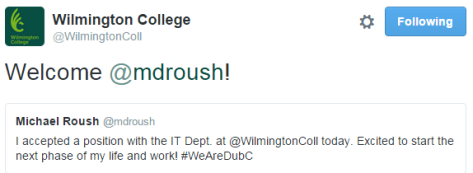
On Wednesday, August 26, 2015, I will be starting the next chapter of my life.  I have accepted a position in the IT Department of Wilmington College as a Customer Service Coordinator.  I will be responsible for designing and delivering professional development and technical assistance for students and staff on technology applications.  I will also coordinate the Help Desk, staffed by students.

Every interaction I have had with Wilmington College in the past has been a positive one, so I was thrilled when the opportunity came along for me to join their team.  I was so enthusiastic about the offer, I tweeted about it.  Soon after, I received a tweet back from Wilmington College, welcoming me to the family. Tweet from WC, "Welcome @mdroush".

A tweet is a small thing, but the value system behind sending a little message like this acknowledging my enthusiasm is a big part of why I’m looking forward to getting started with this new phase of my life.  #WeAreDubC #GoQuakers

Refocusing on the “Why”

I’m looking for a new job.  It’s a bit nerve-wracking.  I know I am capable of doing valuable work, but the great difficulty is always in finding someone who has a place for me.

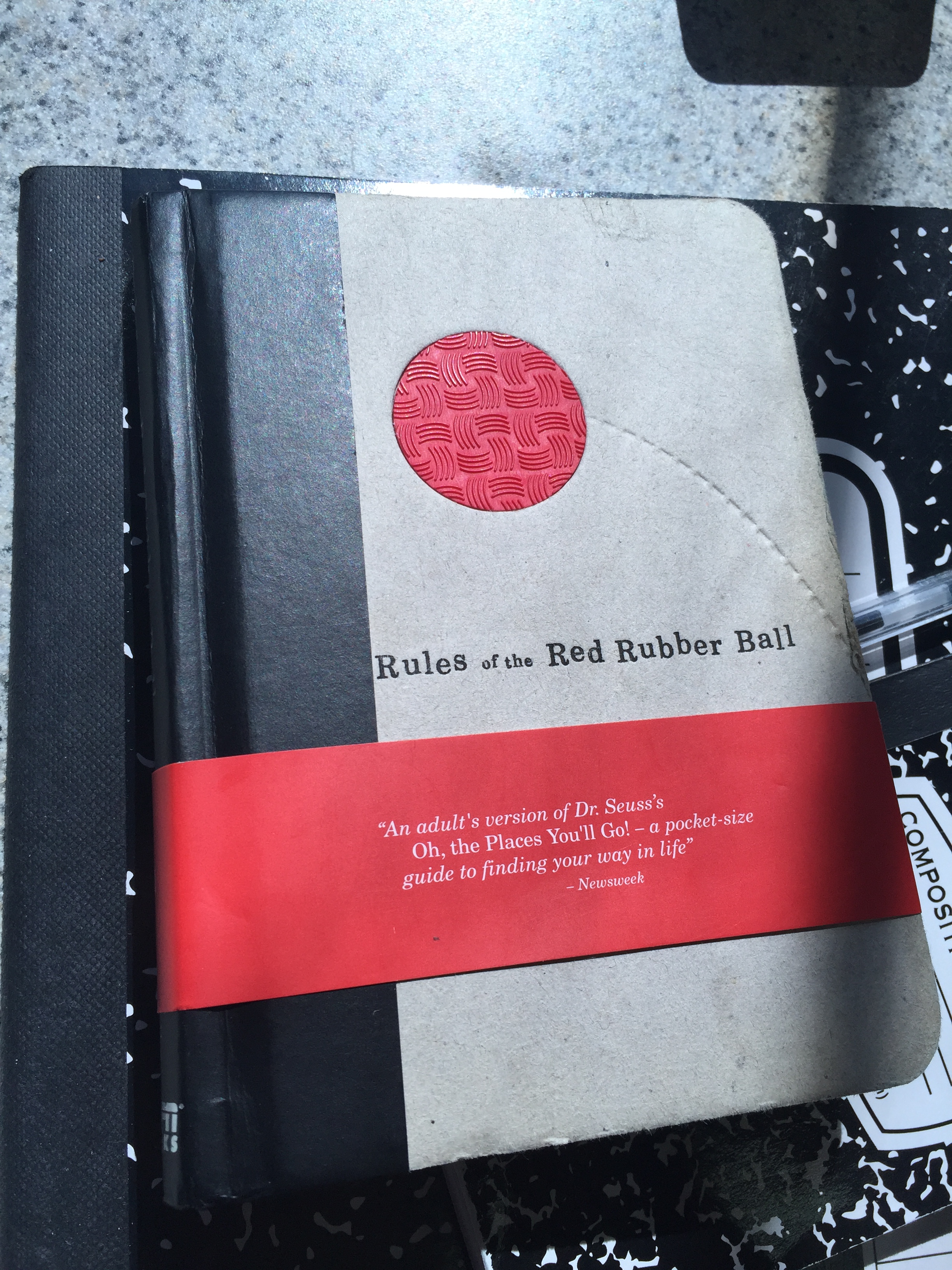
Rules of the Red Rubber Ball, book by Kevin Carroll
Rules of the Red Rubber Ball, book by Kevin Carroll.

During this time, I decided to re-read a little book that has been one of my favorites for the last few years.  The book is “Rules of the Red Rubber Ball” by Kevin Carroll.  In this quick read, Mr. Carroll lets the reader into his life, and guides the reader through the experiences that helped inspire him to accomplish what simply would not have been possible in a passionless system.  I needed to re-read those words as I prepare for whatever comes next in my professional life.

Because, whatever I do for a job, my passion and my mission are still the same.  I want to help every person (especially K-12 students and those who work with them) learn to be able to define and achieve what the highest level of success means for them.

This led me back to a favorite TED video from the TEDxPugetSound event, Simon Sinek on “How great leaders inspire action”.  I’ve dealt for a long time with a world that is compulsively focused on the “what” and sometimes the “how” of education.  Some have concluded that there is no value in spending time and thought on formally defining the “why”.  Some have concluded that it is dangerous to define the “why”.  They may be right.  But, just as a full physical examination cures nothing, it is a necessary step in learning where curative resources must be focused. 

I am refocusing myself on my “why”.  In practical terms, this has made it much easier for me to look at possible job opportunities and decide whether to pursue them.  It’s not just about whether my skill set matches the job expectations, it’s about whether the work matches my life’s passion.

I’m spending a lot of time with my “red rubber ball” this week.  Rather than keeping me from finding my next job, I firmly believe it is helping me find the next job that will help me continue pursuing my purpose and my passion.

I wish the same for each and every person who reads this.

Ch…ch…ch…ch…changes

I’m making some changes.

For a few years, there have been some things that just weren’t quite right, or like they should be for me. This was a tough decision to come to, but I have resigned from my job as part of the Region 14 State Support Team, and as Technology Coordinator for Hopewell Center.

My wife, Angie, has been, and still is, a rock for me, and I couldn’t have made it through the last several years, or the last several days, without her. Thank you, sweetheart.

My heart and my passion in work is still to help every kid get the opportunities they deserve in education, because every student can learn, and can learn to define and achieve what the highest level of success means for them. Whatever I do for work from here, that will still be my mission.

Many of you on here are my friends because of work affiliations. I am grateful for everything you have taught me, and I look forward to learning more and continuing to do awesome things for the kids who need it most.

Web Accessibility and Online/Blended Learning Environments

The emerging field of online/blended learning environments holds great promise for students with a wide variety of challenges.  However, the mere fact of a course being all or partly online does not automatically give many students more of a chance of being successful.

In short, the field needs much more attention to furrowing and fertilizing than has yet been afforded it.  Students who would have done exemplary work in a traditional classroom setting doing exemplary work in an online/blended setting is no evidence that the online/blended setting holds any special value at all.

Tonight, I have the opportunity to speak with an online class about Universal Design for Learning from the particular perspective of providing flexible, engaging learning environments and experiences in the online/blended learning model.

If I were the sort who could crank out a few thousand words a week, this could be my next book.

I have a google doc of the resources that I am using.  It will continually evolve.  You are welcome to look, use, and comment.

goo.gl/lBsyXQ

edCamp Cedarville

Tomorrow (Saturday, May 9, 2015), I’m registered for edCamp Cedarville.  This should be a nice opportunity, since it should be less than a 90 minute drive for me.  I am mulling possible session topics to suggest.  These have made the cut so far:

  • Buy or Sell: Inclusive Education
  • The current state and future of special education
  • a design challenge…. (possibly the hamster habitat one?)
  • Re-thinking Learning Spaces (using futurelab’s Diamond 9 cards)

I may not decide until I get there tomorrow… that’s one of the coolest parts of edCamp!

Follow me on twitter, and follow the #edcampcedarville hashtag to see what happens!

Writing Tools Workshop

During my Tech Tools to Support the Five-Step Writing Process workshop in Piketon, OH, last Friday (5/1/15), groups used Rory’s Story Cybes to write “Somebody… – Wanted… – But… – So…” stories today.  Here are the two brave souls who agreed to record their stories!

Story #1

Story #2

The Five-Step Writing Process CAN be done quickly!  And combining the picture manipulatives with the “Somebody… Wanted… But… So…” formula helps writers construct a fun story in just a few minutes!

Thanks to everyone who made this workshop so much fun!